
Blocked Drains in Yorkshire: Causes, Costs, and How to Clear Them
Blocked drains in Yorkshire? Understand the common causes — fat, roots, collapsed clay pipe — what it actually costs to clear them, who's responsible, and how a CCTV survey stops the problem coming back. Local guide for LS/BD/S/HU postcodes.
What Causes Blocked Drains in Yorkshire?
Blocked drains are one of the most common drainage problems in Yorkshire homes, especially in the region's large stock of Victorian and Edwardian housing. The cause matters: the right fix depends entirely on what's actually blocking the pipe. Treating a structural collapse like a fat blockage is how you end up paying three separate contractors for a problem that one proper survey would have closed out in a single visit.
Fat, oil, and grease build-up
Cooking fat poured down the sink solidifies as it cools, sticking to pipe walls and accumulating over months and years. This is the leading cause of domestic blockages in Yorkshire — Yorkshire Water reports that fat-related blockages cost the network millions every year. It's particularly bad in HMO and student-let property in Leeds (LS6, LS2, LS4), Bradford (BD8, BD9) and Sheffield (S10, S11) where shared kitchens see far higher fat volumes than single-family households.
Symptoms typically start slowly: a kitchen sink that takes a moment longer to drain, gurgling when the washing machine empties, occasional smells. By the time it surcharges and you find waste backing up, the fat has often been narrowing the pipe diameter for months.
Tree root ingress
Tree and shrub roots seek moisture, and the smallest crack in a clay pipe joint is enough for them to enter. Once inside, roots grow into mat-like masses that snag debris and slow drainage. Bradford, Leeds, and Sheffield all have significant tree-lined Victorian streets where this is endemic — particularly the wider terraced streets in LS6, LS7, LS8, LS11, BD8 and S2-S11 where mature street trees were planted alongside drainage built of Victorian-era clay pipe with mortar joints. Hundred-year-old mortar isn't a great seal.
In rural Yorkshire — anywhere with a hedge line near a drain run — the problem is similar. Wensleydale and Wharfedale properties on private septic systems often see root invasion in the pipework leading to the tank, not in the tank itself.
Foreign objects
Wipes (even the ones marked "flushable"), sanitary products, nappies, kitchen roll, cotton buds and food waste don't break down in drains the way toilet paper does. They snag on pipe imperfections and accumulate fast. Households with young children, HMOs, and student lets see this most often. The "three Ps" rule applies — pee, poo and paper. Anything else belongs in the bin.
Collapsed or damaged pipework
Older clay drainage — common in pre-1970 Yorkshire properties — eventually fails. Cracks, displaced joints and partial collapses create points where debris collects and blockages form repeatedly. Clearing the pipe doesn't solve a structural problem; only a CCTV survey will reveal it. Collapses are particularly common in South Yorkshire mining country (S64, S66, S70-S75) where settlement on undermined ground has gradually displaced drainage joints over decades.
Sags and bellying
A pipe that has settled out of gradient creates a low point where water and waste pool. Standing waste solidifies, and the section blocks again every few months. A camera survey is the only way to identify a belly — they look like a normal blockage from the surface, but the recurrence pattern is the giveaway. If you've cleared the "same" blockage two or three times in 18 months, it isn't actually the same blockage — it's a sag re-filling each time.
Silt and scale build-up
Low-gradient drainage — common in Hull and the wider East Riding (HU and HD postcodes) — accumulates silt because there isn't enough fall to self-clean. The same goes for parts of the Vale of York. On the other end of the spectrum, older clay pipes in hard-water areas develop limescale that gradually narrows the bore. Neither needs excavation to put right, but both need targeted high-pressure descaling rather than a quick rod-through.
How Do I Know What's Causing My Blocked Drain?
The honest answer: you don't, until you put a camera on it. Trying to clear a structural defect with a drain rod or a bottle of caustic drain cleaner wastes time and often makes things worse — caustic chemicals can actually accelerate pipe deterioration in older clay drains.
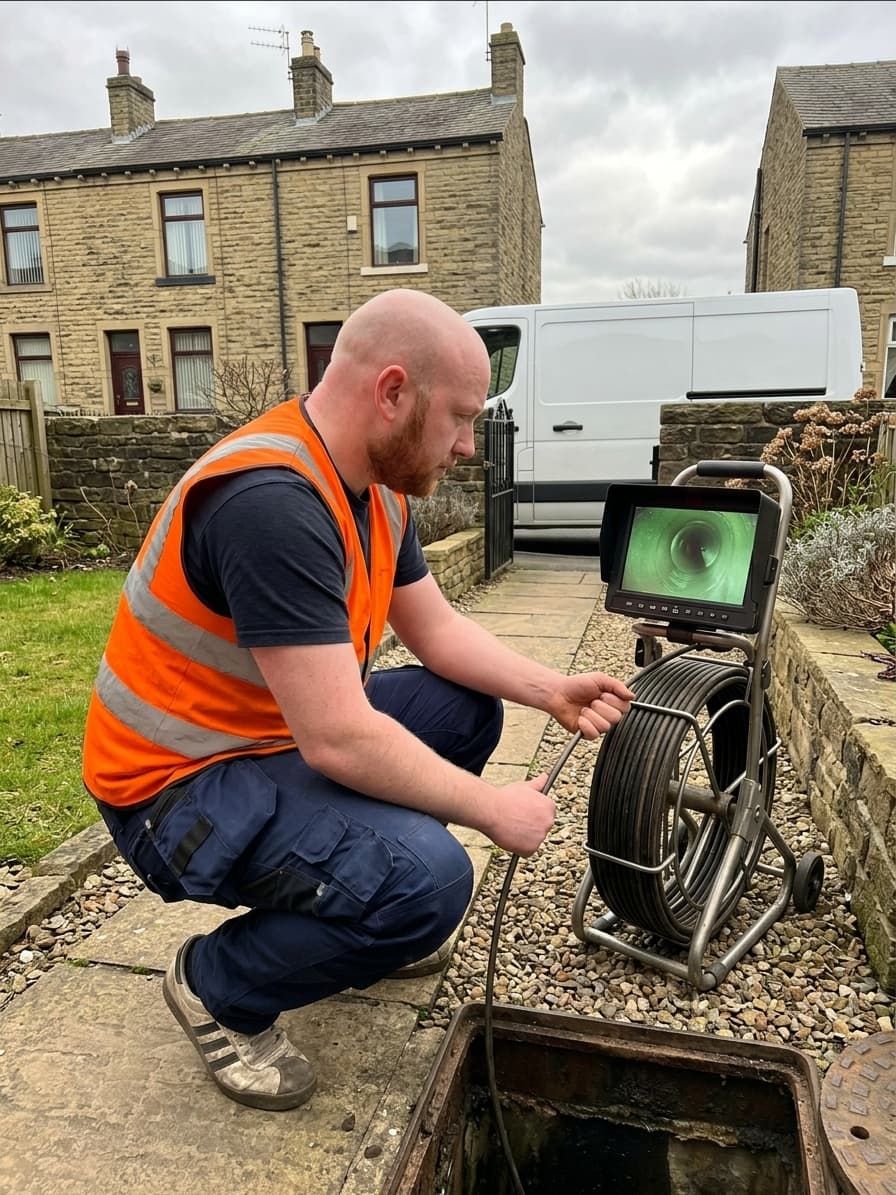
A CCTV drain survey feeds an HD camera into your drainage system and shows the cause on screen — fat, roots, foreign object or structural defect — along with its precise location measured from the access chamber. Most surveys take 1–2 hours and produce a written report the same day, with MSCC5 defect coding that's recognised by insurers, lenders and Building Control.
For Yorkshire homeowners, the survey-then-clear approach is almost always cheaper than repeated call-outs to clear a recurring blockage whose underlying cause was never diagnosed. Several separate emergency call-outs — which is what an unsurveyed recurring blockage tends to need — easily add up to more than a single visit that combines clearance with diagnosis.
Whose Problem Is It — Yours or the Water Company's?
A common Yorkshire question, especially in terraced streets. The short version, after the 2011 transfer of private drainage to water companies:
- Inside your boundary, serving only your property: Your responsibility.
- Inside your boundary, but serving multiple properties (a shared lateral drain): Usually Yorkshire Water's responsibility, even though it's on your land.
- Beyond your boundary: Yorkshire Water's responsibility.
In practice, a lot of Victorian terraced streets in LS, BD, WF and S postcodes have shared boundary drains running under the back gardens of several properties. If your blockage turns out to be on the shared portion, Yorkshire Water will usually clear it free of charge — and our CCTV survey will tell you exactly where the blockage is so you know which call to make. We routinely refund the survey portion of our fee for clients where the issue turns out to be a public-sewer responsibility, because our job is to give you the right answer, not to take payment for work that wasn't yours to fund.
What Affects the Cost of Clearing a Blocked Drain?
The cost of clearing a blocked drain in Yorkshire depends on what's causing it and how it's accessed, which is why we always quote upfront once we understand the job rather than quoting blind over the phone. As a rough guide to relative cost, a standard residential unblock with a diagnostic CCTV pass is the most affordable option; root-cutting and descaling an extended run sit higher; and structural repairs — no-dig patch repairs, full pipe lining (CIPP) or excavated repair of a collapsed section — are the larger jobs, quoted individually once the survey shows exactly what's needed.
The main factors:
- Type of blockage — fat and silt are quickest to clear; root mats and structural failures take longer
- Whether a CCTV survey is needed first — recommended for recurring blockages or unknown causes (and included free with most of our clearances)
- Access difficulty — buried inspection chambers, restricted side access or rural sites add time
- Severity — surface blockages clear with jetting; collapsed pipes need excavation or no-dig lining
Combined survey and clearance is the most cost-effective approach for recurring blockages: you find the cause and fix the symptom in one visit. We quote upfront before we arrive, with no hidden charges, no call-out fees and no fuel surcharges for outlying postcodes.
Why Use Professional Drain Engineers?
Professional drain surveys use industry-grade equipment — like iTouch CCTV camera systems and Radiodetection sonde tracing — operated by experienced engineers who can interpret what they're seeing. A consumer drain camera and a YouTube tutorial will not satisfy Building Control, a mortgage lender or a solicitor — and won't pick up a partial collapse that a trained eye spots in seconds.
For tenants and landlords especially, an independent professional report is often the difference between a fair tenancy dispute outcome and a costly one. See our drain surveys for Yorkshire landlords guide for more on this — including who's responsible for clearance under different tenancy types and what evidence stands up at deposit-protection arbitration.
Insurance claims are another area where DIY clearance backfires: most policies require evidence of the cause and circumstances, which means CCTV footage and a defect-coded report. A blocked drain you cleared yourself with a rented jet is a claim you'll likely lose.
How to Prevent Blocked Drains
A few practical habits prevent the majority of avoidable blockages:
- Never pour cooking fat or oil down the sink — let it solidify in the pan, bin it, or recycle locally (most Yorkshire councils accept used cooking oil at recycling centres)
- Use sink strainers in kitchen and bathroom drains — they catch food scraps and hair before they reach the pipe
- Don't flush wipes, sanitary products or cotton buds — only the three Ps: pee, poo and paper
- Schedule a CCTV survey every 5–10 years for older properties, especially those with mature trees nearby or in mining-affected ground
- Have a survey before buying a property — a Homebuyer Drain Survey identifies issues you'd otherwise inherit at completion
- In hard-water areas, jet-descale every 10–15 years to keep clay pipe bores at full diameter
- For HMOs and student lets, consider an annual planned jetting cycle — much cheaper than reactive call-outs during term time
Frequently Asked Questions
What is the most common cause of blocked drains in Yorkshire?
Fat, oil and grease build-up is the most common cause of domestic blocked drains in Yorkshire, followed by tree root ingress in older clay pipework and foreign objects flushed down toilets. In South Yorkshire mining country (Mexborough, Maltby, Wombwell), settlement-induced joint failure is also a significant pattern.
How do I know if my drain is blocked or collapsed?
A blocked drain typically clears with high-pressure jetting and stays clear; a collapsed drain either doesn't clear at all, or clears and blocks again within weeks. The only reliable way to tell the difference is a CCTV drain survey, which shows the pipe condition directly — looking for cracks, displaced joints, gradient sag and missing pipe sections.
Can I unblock a drain myself?
For minor surface blockages — a kitchen sink slow to drain — DIY methods like a plunger, hot water with washing-up liquid, or a basic hand rod sometimes help. For underground drainage blockages, professional jetting is more effective, won't damage the pipe, and includes a diagnostic CCTV pass so you don't pay twice for the same problem. We'd strongly advise against caustic chemical drain unblockers, which can accelerate deterioration in older clay pipes.
How much does it cost to unblock a drain in Yorkshire?
The cost depends on what's causing the blockage and how it's accessed. A standard residential unblock including the diagnostic CCTV pass is the most affordable option; severe root masses, extensive descaling or jobs requiring multiple access points sit higher; and structural defects (collapse, patch repair, lining) are quoted separately based on what the survey finds. We give you a fixed quote upfront before any work begins — no call-out fees and no hidden charges.
How quickly can you clear a blocked drain?
We offer same-day service for blocked drains across Yorkshire where availability allows — calls before midday are typically attended the same afternoon on weekdays. Most clearances are completed in a single 1–2 hour visit, with a written report and footage provided the same day.
Is the blockage on my property or Yorkshire Water's responsibility?
It depends on the location. Drainage inside your boundary that serves only your property is yours; shared lateral drains that serve multiple properties are usually Yorkshire Water's responsibility (even on your land) following 2011 legislation; anything beyond your boundary is theirs. Our CCTV survey identifies exactly where the blockage is, so you know which call to make. If it turns out to be on the water company's side, they normally clear it free of charge.
Do you clear blockages in flats and HMOs?
Yes. For flats we clear whatever the lease and freehold structure makes the relevant party responsible for — typically internal stack pipes up to the lateral connection plus any communal drainage. For HMOs and student lets we work directly with landlords and managing agents, and we can quote planned-jetting cycles to break the reactive call-out pattern that costs HMO landlords significant money each year.
What if jetting doesn't clear the blockage?
If high-pressure jetting can't shift the obstruction, it's almost always because the blockage isn't really a blockage — it's a structural defect (collapse, severe displacement, foreign object too large to break up). Our CCTV pass will identify the cause and we'll show you what we found. From there the options are typically no-dig patch repair, pipe lining, or excavation — quoted separately based on the specific defect.
Get a Blocked Drain Cleared Today
If you've got a blocked or recurring drain issue in Yorkshire, don't wait for it to become an emergency. We cover Leeds, Bradford, Sheffield, Wakefield, Huddersfield, Halifax, York, Hull, Harrogate and the wider region.
📞 Call us on 0113 734 2245
📋 Or fill in our online form for a fast, no-obligation quote.
Same-day available. Full written report by close of business. No call-out fees.
Related reading
- CCTV Drain Survey Yorkshire — what's included, how long it takes, what the report covers
- Drain Unblocking — service overview — jetting, root cutting, descaling
- Common Causes of Blocked Drains in Yorkshire — deeper dive into causes
- How to Prevent Blocked Drains in Yorkshire — preventative habits and maintenance
Related guides
How to Prevent Blocked Drains in Yorkshire
Practical tips to prevent blocked drains in Yorkshire homes — what causes blockages, the early warning signs, and how regular maintenance keeps drains flowing.
Read guide →Common Causes of Blocked Drains in Yorkshire (And How to Spot Them Early)
Discover the most common causes of blocked drains in Yorkshire, from wet wipes to tree roots, and how a CCTV drain survey catches problems before they escalate.
Read guide →Blocked Drain Keeps Coming Back? Why Jetting May Not Fix the Real Problem
If your blocked drain keeps returning after jetting, there may be a deeper fault. Learn the common causes and when to book a CCTV drain survey in Yorkshire.
Read guide →Get in touch
Need a CCTV drain survey in Yorkshire?
Same-day available. Full written report. Transparent pricing. Call us or fill in the form.