
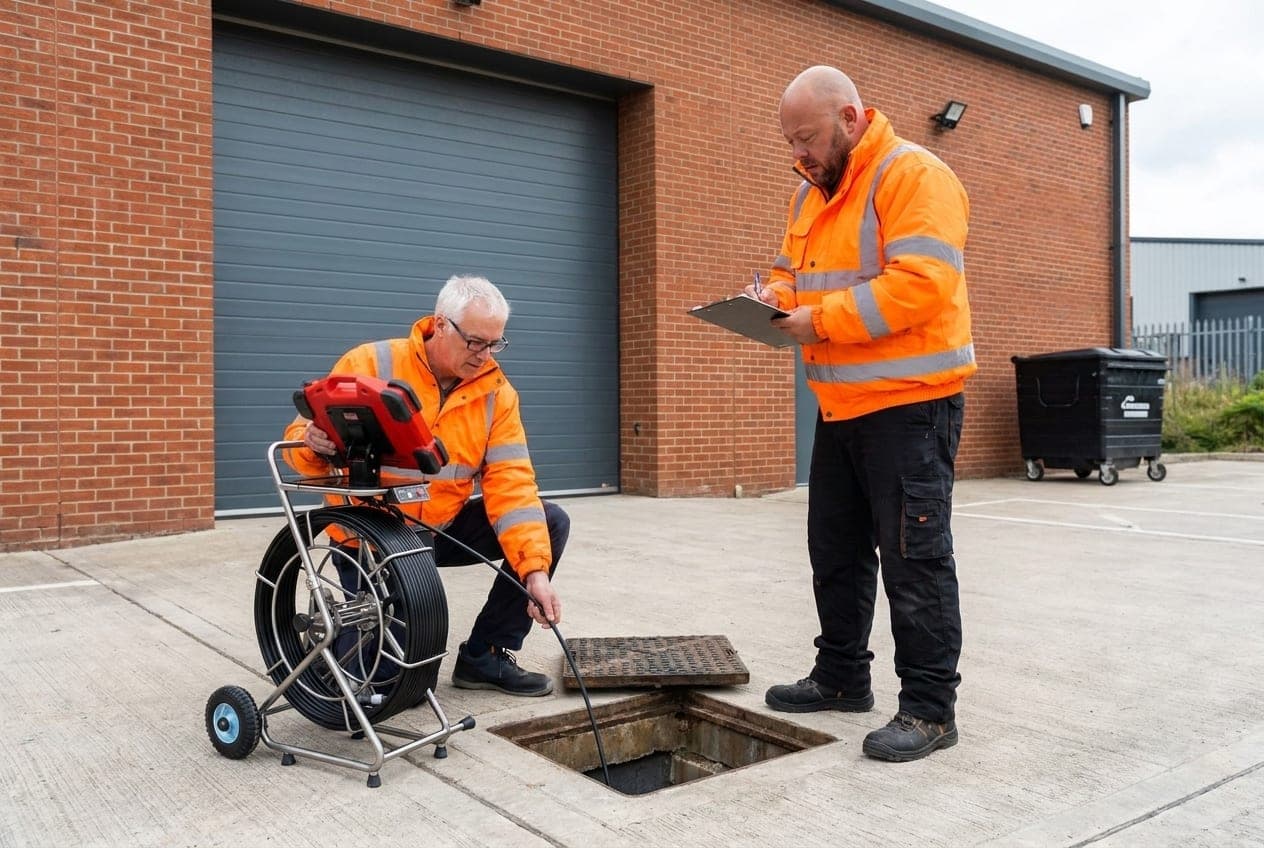
Commercial Drainage Maintenance in Yorkshire: Why Waiting for a Blockage Is the Expensive Option
How commercial drainage maintenance helps Yorkshire businesses prevent blockages, flooding and odours — with CCTV surveys, jetting and planned drain cleaning.
For most commercial properties, drainage only becomes urgent when something has already gone wrong.
A toilet backs up. A kitchen drain starts to smell. A gully overflows after heavy rain. A tenant reports slow-draining sinks. A car park floods. A contractor clears the immediate blockage, everyone breathes a sigh of relief — and the same problem quietly starts building again.
That is the difference between reactive drainage work and proper planned maintenance. Reactive work fixes the visible problem. Planned maintenance finds out why it happened, removes the build-up before it becomes a blockage, and gives property owners a clear record of the system's condition.
For Yorkshire businesses, landlords, facilities managers and commercial property owners, that matters. Drainage failures can stop trading, create health and safety issues, damage stock, disrupt tenants, trigger odour complaints and lead to avoidable repair costs.
What is commercial drainage maintenance?
Commercial drainage maintenance is the regular inspection, cleaning and management of a property's underground drainage system. Depending on the site, it can include:
- CCTV drain surveys
- High-pressure water jetting
- Drain unblocking
- Root cutting
- Descaling
- Gully cleaning
- Grease trap maintenance
- Interceptor checks
- Drain tracing and mapping
- Post-cleaning camera inspections
- Written condition reports and recommended repair schedules
The aim is simple: keep water and waste flowing properly, reduce the risk of emergency call-outs, and identify defects before they become more expensive to fix.
A good maintenance plan should not be based on guesswork. It should start with an inspection — usually by CCTV — so the contractor can see what is actually happening inside the pipework.
Why commercial drains block
Commercial drains usually have a harder life than domestic drains. Restaurants, schools, care homes, factories, offices, retail parks, leisure sites and industrial units all put different pressure on their drainage systems.
Common causes of commercial blockages include:
- Fat, oil and grease from kitchens
- Food waste and debris
- Silt and leaves in gullies
- Tree root ingress
- Scale build-up
- Wet wipes and sanitary products
- Collapsed or displaced pipework
- Poor gradients and damaged joints
- Heavy rainfall overwhelming surface water drains
- Historic pipework that has never been mapped properly
Food-led businesses carry a particular risk. Fat, oil and grease enter the system as a liquid, then cool, congeal and cling to the pipe wall — gradually restricting flow until it blocks. Water industry guidance highlights the incorrect disposal of fats, oils and grease as a major cause of sewer blockages across the UK. Our guide to the common causes of blocked drains covers each in more detail.
Why a CCTV survey should come before the maintenance plan
A blocked drain can often be cleared quickly, but that does not mean the underlying issue has gone away.
If roots have entered a cracked clay pipe, jetting may clear the immediate obstruction and the drain will flow again — but unless the defect is repaired, the roots are likely to return. The same applies to pipes affected by scale, broken joints, poor falls or structural damage. Without a CCTV survey, you are only treating the symptom. (For the distinction, see drain jetting vs a drain survey.)
A CCTV drain survey gives you:
- Footage of the pipe condition
- The exact location of any defects
- Evidence of root ingress, cracks, fractures or displaced joints
- A written report with photographs or still images from the footage
- A record you can use for landlords, insurers, surveyors or maintenance planning
- A basis for deciding whether cleaning, repair or further investigation is needed
Yorkshire Drain Survey provides CCTV drain surveys across Yorkshire with written reports and clear recommendations — especially useful for commercial sites where repeat disruption is costly and decisions need to be documented.
Reactive drain unblocking vs planned maintenance
Reactive drainage work is still important. If sewage is backing up, water is flooding a yard, or a tenant cannot use a toilet, the immediate priority is to restore flow with prompt drain unblocking.
However, reactive work alone has three problems:
- It usually happens at the worst possible time.
- It can cost more because the issue is urgent.
- It may not explain why the blockage happened.
Planned maintenance treats the drainage system as an asset that needs monitoring. Instead of waiting for failure, the system is checked and cleaned at sensible intervals. For some sites that means a yearly CCTV survey and targeted jetting; for others — especially food premises, retail parks, industrial yards or older buildings — it may mean a more regular programme.
Which Yorkshire businesses should consider planned drainage maintenance?
Planned maintenance is worth considering for any site where drainage failure would cause operational disruption, reputational damage or safety concerns. Typical examples include:
Restaurants, pubs, takeaways and commercial kitchens
These sites are exposed to fats, oils, grease and food waste. Even with good kitchen procedures, the drainage system should be monitored.
Schools, colleges and nurseries
High footfall, heavy toilet use and limited closure windows make prevention far better than emergency repairs.
Care homes and healthcare settings
Drainage issues can quickly become a hygiene and safeguarding problem.
Industrial units and factories
Large sites often have mixed drainage — gullies, interceptors, surface water drains and older unmapped pipework.
Retail parks and commercial estates
A single blockage can affect multiple units, car parks, service yards or shared drainage runs.
Landlords and property managers
CCTV evidence helps separate tenant misuse, structural defects and maintenance responsibility.
Hotels and leisure venues
Odours, flooding or toilet closures can damage the customer experience quickly.
What should a commercial drainage maintenance visit include?
A proper visit should be more than a quick jet and go. A useful maintenance visit may include:
- A site discussion and review of known drainage issues
- Manhole and chamber inspection
- A CCTV survey of accessible pipework
- Jetting where build-up or obstruction is found
- Root cutting or mechanical cleaning if required
- Gully and surface water drain checks
- A review of grease-related risk if the site has kitchens
- A post-cleaning camera check
- Clear written findings
- Recommendations for repair, re-survey or future cleaning intervals
The most important part is the report. Without a record, the business relies on memory and verbal advice. With a report, you can plan work, compare future surveys and prove that maintenance has been carried out — see what happens after a CCTV drain survey.
Safety matters too
Drainage work can involve confined spaces, contaminated water, high-pressure jetting and hidden risks around manholes and chambers. High-pressure water jetting should be carried out by trained, competent operators using appropriate equipment and recognised safe working practices, as set out by the Water Jetting Association.
Confined space work also needs careful control. The Health and Safety Executive advises that confined space entry should be avoided where possible and, where unavoidable, that risks are assessed and properly controlled.
For commercial clients, this is another reason to use a professional drainage contractor rather than treating drainage as a basic handyman job.
How often should commercial drains be cleaned?
There is no single schedule that suits every site. The right interval depends on:
- Site use and volume of wastewater
- Whether food is prepared on site
- The age and material of the pipework
- History of blockages
- Tree cover and surface water risk
- Whether the site has gullies, interceptors or grease traps
- Whether drainage drawings are accurate
- The results of the first CCTV survey
A sensible approach is to start with a baseline CCTV survey. That gives you a real picture of pipe condition, and from there you can decide whether the site needs annual, six-monthly, quarterly or targeted maintenance.
Why local knowledge matters in Yorkshire
Yorkshire has a wide mix of drainage conditions. Victorian terraces, stone-built rural properties, industrial estates, former mill sites, commercial parks, new developments and converted buildings all behave differently.
A commercial site in Leeds may face different risks from one in York, Bradford, Sheffield, Huddersfield, Harrogate, Wakefield, Hull or a rural North Yorkshire village. Local knowledge helps because the contractor understands the common pipe materials, ground conditions, older layouts and shared drainage issues seen across the region. Where a site's layout is unknown, drain tracing and mapping establishes exactly where the runs go.
When to book a commercial CCTV drain survey
Consider a commercial survey if:
- You have had more than one blockage
- Drains smell even after cleaning
- Gullies overflow during rainfall
- Toilets or sinks are slow to drain
- You manage a site with food preparation
- You are taking on a lease or buying a commercial property
- You are planning building works
- You need evidence for insurers or landlords
- You do not have accurate drainage plans
- Rats or pests may be entering through defective drains
A CCTV survey is often the difference between clearing a blockage and solving the problem properly.
Frequently Asked Questions
Is commercial drainage maintenance a legal requirement?
There is no single law that says "clean your drains on this date", but businesses do have duties around health, safety and hygiene, and most commercial leases place drainage upkeep on the occupier or owner. Planned maintenance and documented CCTV evidence are the practical way to show those duties are being met.
Who is responsible for commercial drain repairs — landlord or tenant?
It depends on the lease and where the defect sits. A CCTV survey with a written report helps separate tenant misuse from structural defects and clarifies whether a problem is on private pipework or a shared/public sewer, so responsibility can be agreed on evidence rather than opinion.
How long does a commercial CCTV drain survey take?
It depends on the size of the site, the number of runs and the access available. Many surveys are completed in a single visit, and we confirm a fixed quote upfront before attending.
Can you work outside trading hours?
Yes — for many commercial sites we can schedule surveys and cleaning to minimise disruption, including early mornings, evenings or quieter periods, so trading and tenants are affected as little as possible.
The bottom line
Commercial drainage maintenance is not just about keeping pipes clean. It is about protecting your property, reducing disruption and making informed decisions. For Yorkshire businesses, a planned approach helps prevent emergency call-outs, identify defects early and keep sites operating safely.
Yorkshire Drain Survey can inspect, report and advise on commercial drainage systems across Yorkshire, helping property owners and facilities teams move from reactive repairs to proper drainage management.
Call 0113 734 2245 or request a free quote to discuss a commercial CCTV drain survey or a planned drainage maintenance visit.
Related guides
The Importance of Regular Drain Maintenance in Yorkshire
Why regular drain maintenance matters for Yorkshire homes — how it prevents blockages, the warning signs to watch for, and how often to book a CCTV inspection.
Read guide →Why Regular Drain Surveys Are Essential for Yorkshire Homeowners
How regular CCTV drain surveys protect Yorkshire homeowners — what a survey involves, why it matters, and the common drainage issues it catches early.
Read guide →Drain Maintenance in Yorkshire: Why It's Crucial for Homeowners
Why regular drain maintenance matters for Yorkshire homeowners, and how a CCTV survey catches problems early and saves you from costly repairs.
Read guide →Get in touch
Need a CCTV drain survey in Yorkshire?
Same-day available. Full written report. Transparent pricing. Call us or fill in the form.